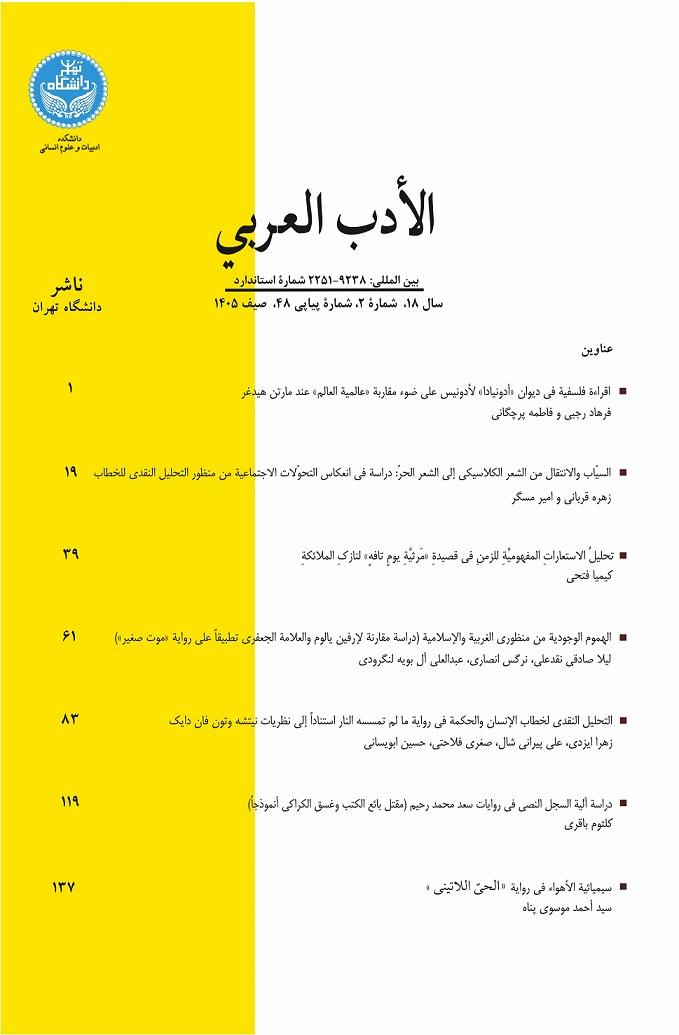
قراءة فلسفیة فی دیوان "أدونیادا" لأدونیس علی ضوء مقاربة "عالمیة العالم" عند مارتن هیدغر

نوع مقاله : مقاله پژوهشی

نویسندگان

1 الاستاذ المشارک، قسم اللغة العربیة وآدابها، کلیة الآداب والعلوم الانسانیة، جامعة گیلان.رشت-ایران.

2 الاستاذة المشارکة، قسم اللغة العربیة وآدابها، کلیة الآداب والعلوم الانسانیة، جامعة خوارزمی. طهران- ایران.

چکیده
ینظر المنظور الفلسفی الهایدغری إلى العالم لا بوصفه مجرّد مجموع من الأشیاء أو علاقات اصطلاحیة، بل مرتبطًا - على مستوى أعمق - ارتباطًا جوهریًا ومستمرًا بمسألة الکینونة (الوجود). إنّ العالم، بذاته، هو نمط من أنماط الکینونة، وتکمن مهمة الفلسفة الحقیقیة فی أن تکون أنطولوجیةً (علمًا للوجود) لهذا العالم. ومن ناحیة أخرى، عندما نعود إلى الأدب والشعر المعاصرین، نجد أنّ إحدى السمات الرئیسیة للشعر الراهن تتمثّل فی تعاطیه مع العالم ومظاهره وعناصره، وکذلک العلاقات المهیمنة علیه، انطلاقًا من هذا المنظور ذاته. فی الأدب العربی المعاصر، یمثّل شعر أدونیس بلا ریب أحد أبرز التجسیدات لهذا المنهج. فأدونیس شاعرٌ فیلسوف، أو فیلسوفٌ شاعر، یستثمر الطاقة الکامنة فی اللغة لرسم رؤیة معرفیّة للکینونة، إلى الحدّ الذی یمکن معه القول إنّ الهاجسَ الشعریَّ المرکزیَّ عنده هو قضیةُ الوجود ذاتُها. ونسعى فی هذه المقالة، مع الترکیز على مفهوم «عالمیة العالم» وبتتبُّع عددٍ محدود من النماذج فی مجموعته الشعریة الجدیدة «أدونیادا»، إلى تقدیم قراءةٍ له تُظهِر هذا الحضور الأنطولوجی. منهجیة هذا البحث وصفیّة-تحلیلیّة، وتشیر النتائج إلى أنّ أدونیس یعمل، تارةً، فی اتّساقٍ مع الرؤى الأنطولوجیّة لهایدغر على خلق النصّ فی فضاء اللغة، وتارةً أخرى یقدّم، بصفته شاعرًا مبدعًا، رؤیةً أکثرَ تقدّمیةً بل ومغایرةً فی تحلیل بعض المحاور. فهو یستثمر إمکانات الشعر، ومن الطبیعیّ أن یحمل الشعرُ، بوصفه کینونةً قائمةً بذاتها، علاقةً أوسعَ وأکثرَ جوهریّةً بتناول القضایا الأنطولوجیّة.

کلیدواژه‌ها

موضوعات

عنوان مقاله English

A Philosophical Reading of Adonis’s Adoniada in Light of Martin Heidegger’s Approach to the “Worldhood of the World”

نویسندگان English

Farhad Rajabi 1
Fatima Parchekani 2
1 Associate Professor, Department of Arabic Language and Literature, Faculty of Literature and Humanities, University of Guilan, Rasht- Iran.
2 Associate Professor, Department of Arabic Language and Literature, Faculty of Literature and Humanities, Kharazmi University, Tehran- Iran.
چکیده English

From the Heideggerian philosophical perspective, the world is not merely a collection of things or conventional relations; rather, it is essentially and continually connected, at a deeper level, to the question of Being. The world itself is a mode of Being, and the task of authentic philosophy is to serve as an ontology (science of Being) of this world. On the other hand, when we turn to contemporary literature and poetry, we find that one of the main characteristics of current poetry is its engagement with the world, its phenomena and elements, as well as the relations dominating it, from this very perspective. In modern Arabic literature, the poetry of Adonis undoubtedly represents one of the most prominent embodiments of this approach. Adonis is a poet-philosopher, or a philosopher-poet, who invests the latent energy of language to delineate an epistemic vision of Being, to the extent that it can be said that his central poetic preoccupation is the question of existence itself. In this article, focusing on the concept of the "worldhood of the world" and tracing a limited number of examples in his new poetry collection, Adoniada, we seek to provide a reading that reveals this ontological presence. The methodology of this research is descriptive-analytical, and the findings indicate that Adonis sometimes works in harmony with Heidegger's ontological insights in creating the text within the space of language, while at other times, as a creative poet, he offers a more progressive and even divergent vision in analyzing certain themes. He invests the potentials of poetry, and it is natural that poetry, as a self-standing being, should have a broader and more essential relationship with addressing ontological issues.

کلیدواژه‌ها English

Worldhood
Ontology
Poetry
Heidegger
Adonis
Adoniada.
إسماعیل، عزّالدین (1996) الشعر المعاصر العربی، بیروت: دارالثقافة.
أدونیس (علی احمد سعید) (2022) أدونیادا، بیروت: دارالساقی.
بعلی، حفناوی (2015) راهن الشعر فی نهایات القرن، عمان: دارالیازوری.
خلیل، ابراهیم (2011) مدخل لدراسة الشعر العربی الحدیث، المطبعة الرابعة، عمان: دراالمسیرة.
محمد أبوجبین، عطاء (2004) شعراء الجیل الغاضب، عمان: دارالمسیرة.
میشال جحا، خلیل (2003) أعلام الشعر العربی الحدیث، بیروت: دارالعودة.
هایدغر، مارتن (2012) الکینونة والزمان، ترجمه: فتحی المسکینی، بیروت: دارالکتب الجدید المتحدة.
أبو فخر، صقر (2022) «أدونیادا... أسئلة الوجود وغیبة الیقین والعودة المستحیلة للمکان الأول»، https://diffah.alaraby.co.uk
شریح، محمود (2022) «أدونیس یصدر أدونیادا... ثنائیة النفس»،https://diffah.alaraby.co.uk/diffah/books/2022/8/13
العلونی، جعفر (2022) «أدونیادا... الشاعر أسطورة»،
الغزی، محمد (2021) «أدونیس یکتب ملحمته أدونیادة على خطى هومیروس وفرجیل»،
 
al-Alouni, Ja‘far (2022). “Adoniada: The Poet as Myth.” al-Araby. https://www.alaraby.co.uk/culture. [in Arabic].
Abu Fakhr, Saqr (2022). “Adoniada: Questions of Existence, the Absence of Certainty, and the Impossible Return to the First Place.” Diffah al-Araby. https://diffah.alaraby.co.uk. [in Arabic].
Adūnīs (ʿAlī Aḥmad Saʿīd) (2022). Adoniadā. Beirut: Dār al-Sāqī. [in Arabic].
Ba'li, Hafnawi (2015). Contemporary Poetry at the End of the Century. Amman: Dar al-Yazouri. [in Arabic].
Joha, Khalil Michel (2003). Luminaries of Modern Arabic Poetry. Beirut: Dar al-Awda. [in Arabic].
al-Ghazzi, Muhammad (2021). “Adonis Writes His Epic Adoniada on the Footsteps of Homer and Virgil.” Independent Arabia. https://www.independentarabia.com/node/237656. [in Arabic].
Heidegger, Martin (2012). Being and Time. Trans. Fathi al-Miskini. Beirut: Dar al-Kutub al-Jadidah al-Muttahidah. [in Arabic].
Ismail, Izz al-Din (1996). Contemporary Arabic Poetry. Beirut: Dar al-Thaqafa. [in Arabic].
Muhammad Abu Jabin, Ata (2004). Poets of the Angry Generation. Amman: Dar al-Masira. [in Arabic].
Khalil, Ibrahim (2011). Introduction to the Study of Modern Arabic Poetry (4th ed.). Amman: Dar al-Masira. [in Arabic].
Sharih, Mahmoud (2022). “Adonis Publishes Adoniada: The Duality of the Self and the World.” Diffah al-Araby. https://diffah.alaraby.co.uk/diffah/books/2022/8/13. [in Arabic].

  • تاریخ دریافت 04 خرداد 1405
  • تاریخ بازنگری 25 شهریور 1405
  • تاریخ پذیرش 27 شهریور 1405